
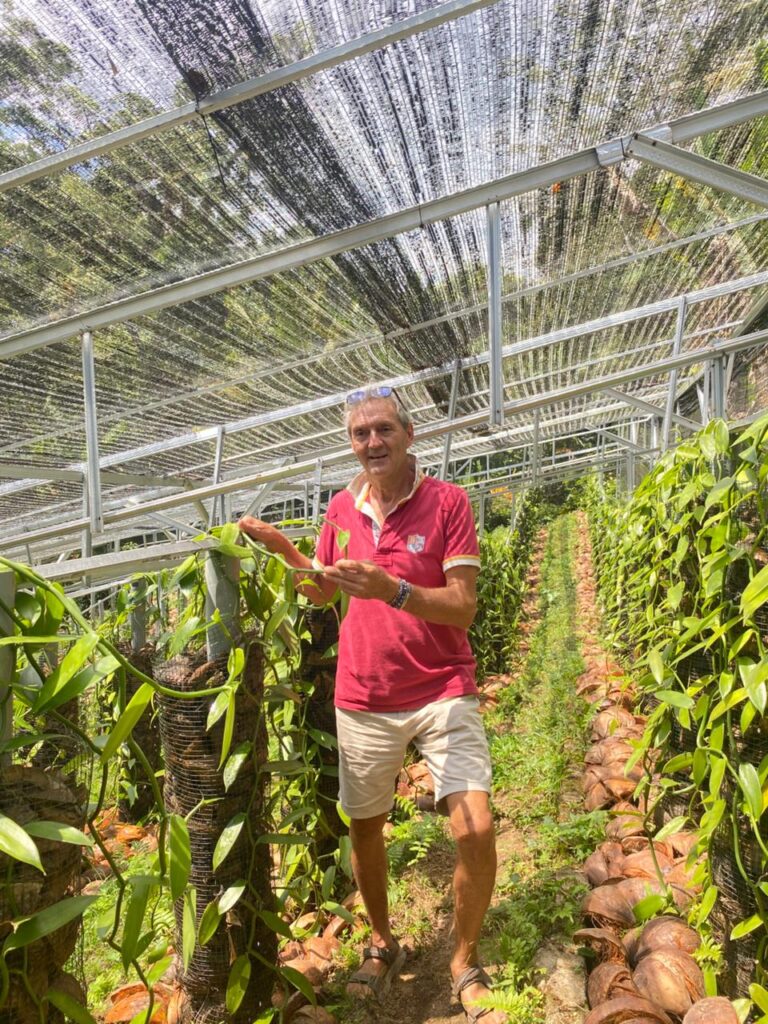
Vanilla is one of the most valuable agricultural commodities in the world. Behind its beautiful aroma and premium value, there is a long story of patience, knowledge, and dedication from farmers. At Vancacao Vanilla & Chocolate Agritourism in Lombok, visitors have the opportunity to discover how vanilla is cultivated through both traditional farming methods and modern agricultural approaches.
This experience is not only about seeing vanilla plants, but also understanding the differences, advantages, and challenges of each cultivation system.
Traditional Vanilla Farming: Learning from Local Wisdom
Traditional vanilla cultivation is a farming method that has been passed down through generations. Farmers rely on experience, observation, and a deep understanding of nature to manage their plantations.
At Vancacao, visitors can learn how traditional farmers care for vanilla plants by utilizing natural systems, including shade management, organic materials, and integrated farming concepts where vanilla grows together with other plants.
One of the most unique parts of vanilla farming is the pollination process. Unlike many crops that depend on natural pollination, commercial vanilla production generally requires human assistance because the flower structure makes natural pollination difficult. Farmers must carefully perform manual pollination during the short period when the flower is ready.
Advantages of Traditional Vanilla Farming:
Preserves local agricultural knowledge
Maintains a closer relationship between farmers and nature
Can support biodiversity through mixed farming systems
Requires simpler tools and lower technological investment
Challenges of Traditional Vanilla Farming:
Requires high labor involvement and farming skills
Production depends heavily on farmer experience
Quality consistency can be more difficult to maintain at a larger scale
Manual processes require significant time and patience
Modern Vanilla Farming: Improving Efficiency Through Innovation
Modern vanilla cultivation combines traditional knowledge with scientific approaches and technology. Farmers can use improved cultivation techniques, better monitoring systems, optimized nutrition management, and controlled environments to improve productivity.
Modern approaches aim to help farmers understand plant conditions more accurately, improve efficiency, and create more consistent production results.
Advantages of Modern Vanilla Farming:
Better monitoring of plant growth
More efficient resource management
Improved consistency of production quality
Potential for larger-scale cultivation
Challenges of Modern Vanilla Farming:
Requires higher investment in technology and infrastructure
Farmers need additional knowledge and training
Excessive dependence on technology may reduce the role of traditional knowledge
Must be carefully managed to maintain environmental sustainability
Finding the Balance Between Tradition and Modern Agriculture
At Vancacao Vanilla & Chocolate Agritourism, visitors can learn that traditional and modern farming methods are not competitors, but can complement each other.
Traditional farming provides valuable knowledge about nature, ecosystems, and local adaptation. Meanwhile, modern agriculture provides tools and innovation that can help farmers improve efficiency and overcome future challenges.
The future of vanilla farming may come from combining the best parts of both approaches: respecting local wisdom while adopting sustainable innovations.
Through this learning experience, visitors can understand that every vanilla pod has a story. It is not only about the plant, but also about the farmers, the environment, and the knowledge required to transform a small flower into a valuable spice.
Come to Vancacao and discover the journey of vanilla from traditional wisdom to future farming innovation.
Vancacao Vanilla & Chocolate Agritourism
Where Agriculture, Education, Nature, and Local Wisdom Come Together.